FORTS OF DEPRESSION
Jahangeer Jamal
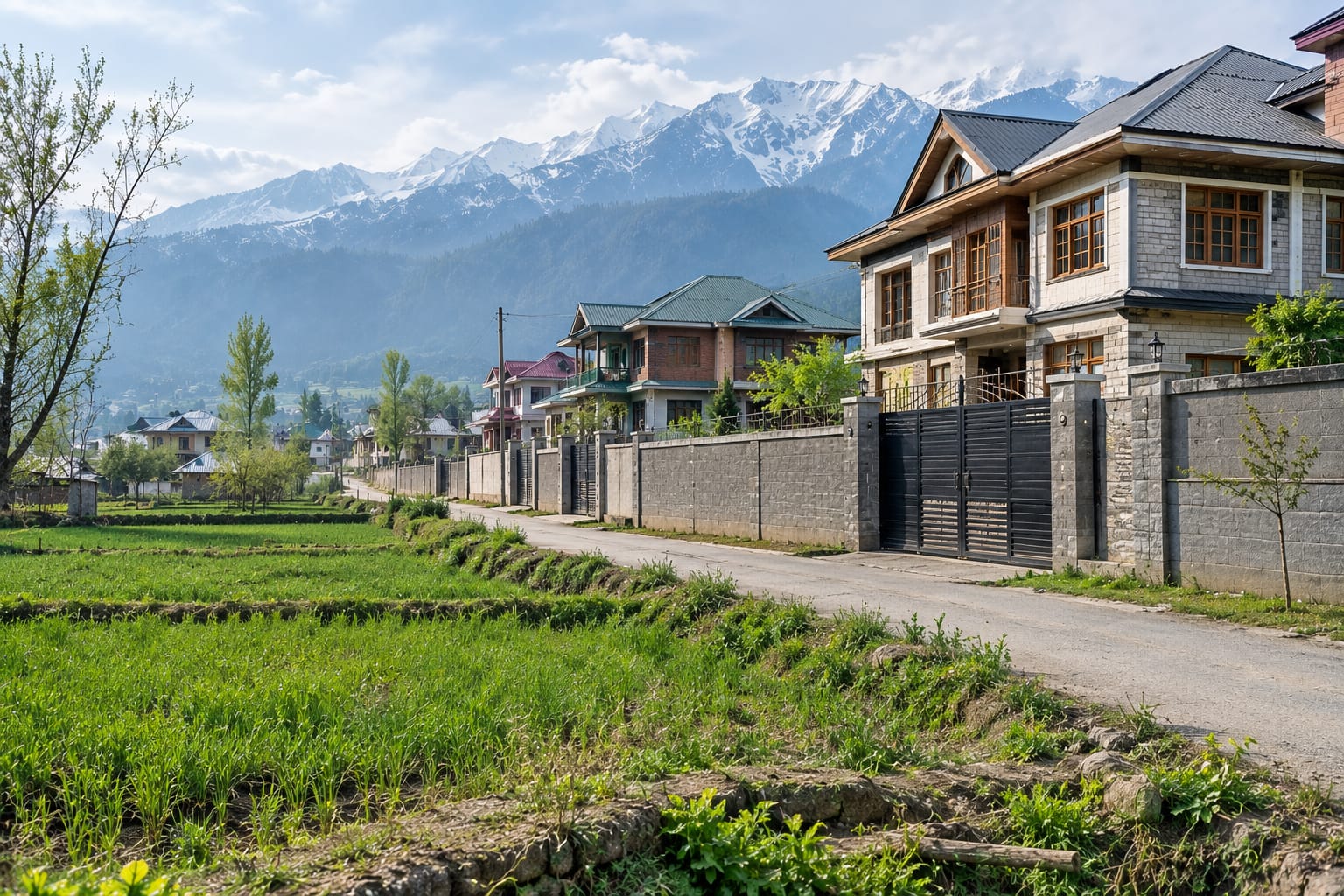
Recently I took a break from busy and competitive city life to visit my village for some fresh air and freedom. As our taxi was entering the village, the air felt somewhat different.
There was a sort of calm and refreshing aura about it. The clear blue sky, birds flying and chirping all around, lush green meadows, snow capped mountains and above all lesser noise.
The childhood memories came flashing back. Those open fields, pure water streams, we as children playing cricket in the fields whose boundaries stretched as far as our eyes could travel.
We played all sorts of games from kabadi to kho-kho and, to fishing and swimming. Our parents had a hard time showing us the way back to the four walls of our homes.
Our parents too used to be busy in the fields and vegetable gardens, wherein women used to gossip for hours. Neighbors and relatives used to visit each other more frequently. Our houses were not that big at the time and automation was yet to come but we were genuinely happy and content.
Coming to the present trip, I was ecstatic to revisit those fond memories and find solace in the battle cries of children lost playing all kinds of sports. I thought I would request them to let me play a few ball, like those uncles used to do back in the days.
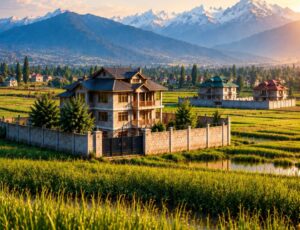
I didn’t realize the nightmare I was about to encounter. I opened the big iron gate of our fenced house and spent some time with the family, but couldn’t hold it for long
I called Idrees, a friend from those happy times and quickly exchanged the grudges before locating each other and catching up.
We went for a walk on the same road where we used to ride our homemade copper wire mold into a circle shape like a tyre on the kuccha road, but this time around it was smoothly covered with tar coal. There was a sudden change in the aura, and memories started to fade.
Those fields and vegetable gardens where we used to eat strawberries and cucumbers have disappeared. There are no battle cries of children, in fact no kids in sight.
I asked Idris why there were no kids playing in the few open fields we could see.
“They go to school, and there is homework to do afterwards,” Idris said.
“But we also went to school and did our homework,” I replied.
Idris sighed and remarked that kids these days scroll through reels on their mobile phones and play video games like PUBG and Free Fire. Besides, there is no neighborhood-wide friendship these days because people rarely visit each other.
At this point, memories of the constant interactions between neighbors came rushing back. I remember that whenever I didn’t like the food at home, my mother would go to a neighbor’s house and bring me what I liked. The favor was reciprocated whenever their children threw a tantrum about the food at their homes. Our parents also visited each other frequently, often taking us along, and we interacted with one another. That was how friendships between children and families grew naturally.
The kids even knew whose mother was best at cooking what. We loved the tomato curry made by Sajida Appa. My friend Usama’s mother was particularly good at cooking chicken with pumpkin. My mother once invited her to our home to cook the dish, and it turned out to be delicious.
These days, when I am home, I rarely see such activity. As I listened to Idris, those memories made me realize how much the social fabric of the neighborhood had changed.
Idris further remarked that there is now a strong consciousness about ownership of land. Nobody wants to go and play on somebody else’s land.
Later, when I talked to “Dr. Wasim Kakru”, a renowned psychologist, he too became nostalgic while sharing similar experiences, lamenting the absence of children in the fields these days.
“It takes a whole village to raise a child,” Dr. Kakru remarked.
He explained that when children hang out and play sports together, they develop virtues such as cooperation, patience and teamwork, while also learning to manage stress and frustration. Unfortunately, in the absence of such interactions, children may lack these skills and may even develop social anxiety.
Talking about virtual gaming, “Dr. Kakru” explained it through an example –“When we played cricket in those open fields that are now fenced, suppose you were the last person to bat. After bowling and fielding throughout the game, your turn finally came, only for you to be bowled out on the very first ball. It could be deeply frustrating for a child, but children learned to cope with that frustration. In doing so, they also learned an important skill: how to handle frustration and setbacks, something they would need later in real life”.

In virtual games, however, you can immediately reset the game and start again. Dr. Kakru argued that this may be one of the factors that can make grown-up people less equipped to deal with setbacks in life—for example, when they fail to crack a competitive examination such as NEET.
I asked Dr. Kakru about the other impacts of this growing isolation.
“Kids staying at home all the time leads to constant friction between parents and children due to excessive preaching and constant surveillance, leading to fractured relationships,” he said.
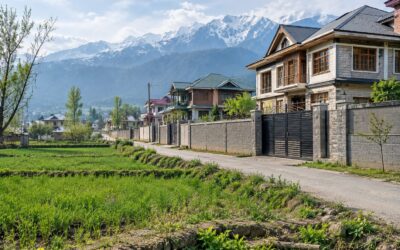
Walking further down the road the only things I could see are brand new cars and mini-forts all along the road with huge cast iron gates. Those open fields where we played are fenced and wired. It was not merely an empty space – They were playgrounds, grazing grounds ,vegetable gardens, fields where rice and mustard was cultivated and an integral part of the rhythm of village life. Their disappearance represents more than a change in land use, it represents change in the way of life.
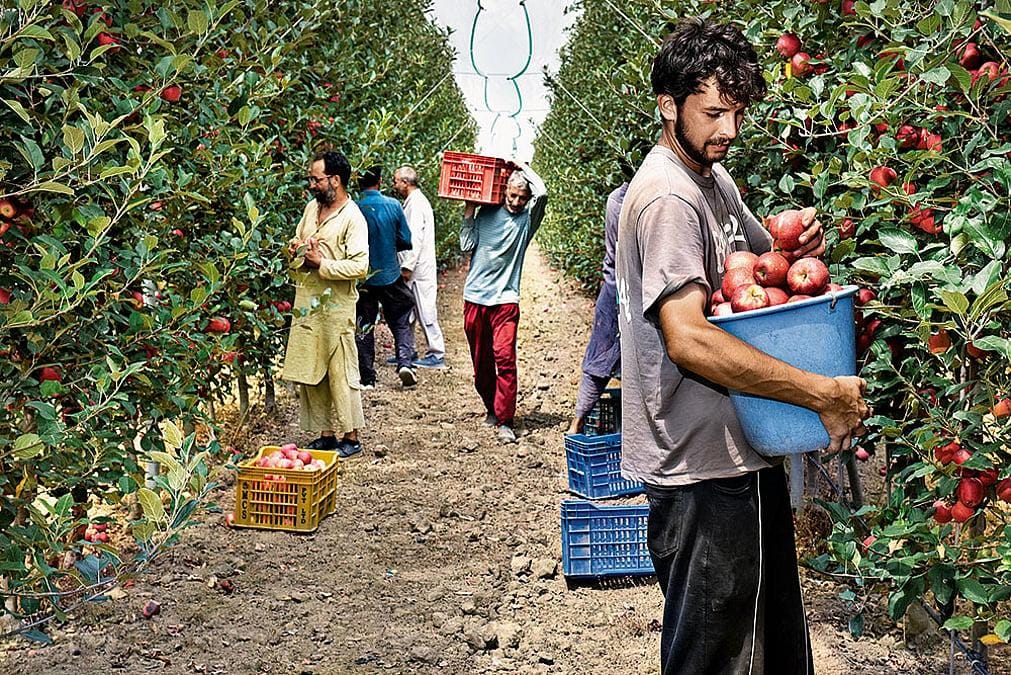
According to Directorate of Economics and Statistics report the region has lost over 30,000 hectares of cultivable farmland between 1996 and 2023 – housing expansion being a factor among others.
This shrinking agricultural base has also intensified concerns over food security, with projections suggesting that the food deficit could widen significantly in the coming years. The higher demand of vegetables from outside the valley, for example, has led to inflationary prices adding another expense to the already stretched incomes.
I still remember the winter preparations of my childhood—the ritual of drying vegetables under the sun and storing them for the harsh months ahead. Those very vegetables once grew in the same patch of land where our house stands tall today. A place that once fed us now requires us to buy food from elsewhere.
On the inside almost everything is automated in these forts and life seems comfortable but there is a catch. Upon my stay I got to know the reality of this comfy looking advanced life of automation, cars, forts and fences. The people living inside turned out to be owned by these things rather being the owners themselves.
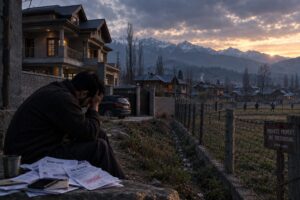
The brand new and the foundation of these forts are built upon highly interest based credit which takes the whole fun out of life. The race of bigger forts and wider cars has chained people to slavery of financial banks. These fancy looking forts have turned into prisons and the air is full of depression.
People are finding it hard to make the ends meet. With the beginning of every new month, which should have ideally been a new start to life, banks take the big bite from peoples incomes like that of Altaf’s.
Altaf is a lower rung government employee who had celebrated his appointment and seemed happy with the salary. But the newly formed, unwritten rule of each brother building a separate house—driven, Altaf claims, by social pressure and decreasing familial bonds– left him with little choice but to take a ₹13lakh bank loan on a salary of 28,000 with the difficult monthly instalments of around 17,000.
After missing a few instalments, his account always stays in the negative, except the day his salary is credited. He checks his account, showing an available balance of 11,000 rupees, which he withdraws quickly with trembling hands for the fear of it getting debited. Altaf recalls how the salary credit message filled him with joy earlier when he lived with his parents and had no debt. Now the same message fills him with resentment, frustration and regret.
Altaf represents a growing number of people in their twenties and early thirties who find themselves constantly under the pressure of EMIs. With two children to raise and nearly two-thirds of his monthly salary committed to repayment, along with the social pressure to own a four-wheeler, Altaf says he can hardly sleep at night.
Sharing Altaf’s situation with Dr. Kakru, he expressed surprise at such decisions and the apparent lack of consideration of their consequences.
“I cannot imagine how a person could raise his family on ₹11,000,” he said. “What if there is a medical emergency at the beginning of the month and you have to spend ₹10,000? You cannot even celebrate a happy moment for lack of funds.”
Dr. Kakru said that such behavior reflects a compulsive tendency when a person fails to weigh the consequences before taking major financial decisions.
“So, what is your advice on taking housing and car loans?” I asked.
“One should take credit as a last resort and only an amount that one can handle easily,” Dr. Kakru replied. “If a person has the ability to pay ₹30,000 as EMI without disrupting his life, he should take only an amount that requires an EMI of around ₹10,000, factoring in unexpected expenses.”

Tanvir, another young man caught in a similar cycle, remembers how different his life was before he took a housing loan and bought a car. He used to take his wife and children on a vacation almost every month and rarely worried about paying their school fees on time. After building his new house and buying a new car, however, even the children’s school fees have become a source of anxiety.
He admits that he has considered selling the car to ease the financial burden. Yet he remains unable to do so, held back not by the loan itself but by the shame of being judged for giving up something he once considered a symbol of success.
Tanvir remembers those weekends almost nostalgically. Once a month, he would put his wife and children in the Maruti 800 and drive somewhere without calculating what the trip would cost him. His children never had to worry about school fees. Now, conversations at home constantly revolve around expenses, including school fees, making the children conscious of the financial pressures their family is facing.
I ask Tanvir why he does not simply execute his plan of selling the new car and drive his old Maruti 800 for the time being. “Everybody in my colony has a new car. When I drove that Maruti 800, people joked about it,” he says. “People will think I have failed.”
His answer reveals that the burden is not entirely financial. There is another cost—the fear of being judged for stepping backwards. “Earlier I used to think about where to take my family. Now all I think about is which bill I can postpone,” he laments.
Sharing Tanvir’s story with Dr. Kakru, he said, “This reflects not just financial illiteracy but a psychosocial issue. A strong, self-confident person does not fall prey to social comparison. It is a person with an inferiority complex who seeks external validation .”
“Such people should consult a psychologist for both stress management and charting a course-correction path before they need medicines,” Dr. Kakru said. “I have worked with such patients in my clinic, helping them regain control of their lives.”
“These people are already stressed about their finances. How can they possibly afford to pay a psychologist’s consultation fee?” I asked.
“There is a psychologist in every government hospital where people can talk to them in a safe and confidential environment, free of cost,” he said.
Tanvir’s story, however, does not mean that owning a car or building a new house is inherently wrong. The problem begins when necessities turn into status symbols and aspirations into a competition that people finance with money they do not have.
Aspiring for a better lifestyle or building a new house is not the problem. A functional car is a necessity and a convenience. My mother once got up in the middle of the night, complaining of a severe headache, stiff neck and vomiting. My brother helped her into his car and got her to the hospital. Her blood pressure had risen sharply, and she received timely medical attention. If my brother did not own a vehicle, it could have been a very traumatic situation for the whole family.
But purchasing an expensive car on a loan for show-off, as a status symbol or as an unannounced competition with neighbors, is proving to be a major problem. The momentary pleasure gives way to years of economic hardship, frustration and loss of mental peace. The seemingly manageable EMIs soon turn out to be a burden, weighing you down like they have done to Tanvir.
Similarly, building a new house is a necessity at times. For example, while talking to Idris about the construction of new houses all along the road, he pointed to two newly built houses with a sigh of relief.
“These houses belong to two of my uncles who moved in there a year ago,” he said.
I remember their families living in a single house with that of Idris’s family. Idris explained that the cousins had grown up and were nearing the age of marriage. The space in their house had become too little, so they mutually decided that his uncles would build new houses while his family stayed in the existing one.
“Have they taken a loan to build these houses?” I asked.
“No,” Idris replied. His uncles had been saving money for years. They were proud of not having to borrow from the bank.
Immersed in this conversation, we had reached back near the gate of our house. Just in front of it, across the road, there is a house under construction that has been in the making for almost seven years.
In contrast to Idris’s extended family, the man building it already lives in a concrete, well-built and comfortable house that I have visited several times. He lives there with just his wife and a single child. The piece of land on which he is building the new house used to be his vegetable garden and rice field.
“What is he building this fort for?” I jokingly asked.
“He is competing with his neighbors, who are also constructing new houses on their farmland,” Idris replied. “You know, he has even taken a big housing loan from the bank.”
“How do you know?” I asked.
“The bank officials came to his house and created a scene because he had defaulted on several EMIs,” Idris replied.
Idris’s account was another reminder that the problem is not simply about building a house or buying a car. It is about what we are willing to sacrifice for them—and whether the life we are building actually gives us the freedom and security we seek.
In short, I feel choked inside these mini-forts. The people inside have made their lives miserable and depressing.
They have imprisoned themselves and keep staring at the walls like inmates. I genuinely believe that our generation should take a few notes.
We should live within our means, take credit only for profitable investments and not for building forts of depression. We need to cancel this petty competition culture for material things.
We should demolish these Berlin-walls at least in our minds, if not physically. And lets come together and show ourselves the way out of this self imposed imprisonment. Let’s take these kids out in the fields and let their eyes cool off; no mobile screens. Let’s be free again!