
Beyond the Classroom: Rethinking School Strategies for True Education

Mohammad Shafi Wani
Education, in its true spirit, is not confined to the transmission of academic knowledge. The fundamental objective of education is the modification of behaviour—the shaping of character, attitudes, and conduct. Mere subject teaching inside classrooms, though necessary, is insufficient to achieve this goal. Schools must therefore adopt a holistic approach that nurtures moral, emotional, and social development alongside intellectual growth
Limitations of Subject-Centred Teaching
Modern schooling largely revolves around syllabus completion, examinations, and grades. While this approach may produce academically competent students, it often fails to develop moral responsibility, self-discipline, empathy, respect, and social awareness. A student may achieve high academic success yet lack ethical judgement or positive social behaviour. This clearly indicates that subject teaching alone cannot fulfil the true objectives of education.
Education as Behavioural and Moral Transformation
Education aims at developing a balanced and responsible human being. Moral education plays a central role in shaping behaviour. Knowledge is not an end in itself; it is a means to refine character and improve conduct. The real purpose of education lies in cultivating values such as honesty, justice, patience, humility, and responsibility. These values form the foundation of good citizenship and are essential for the healthy functioning of society.
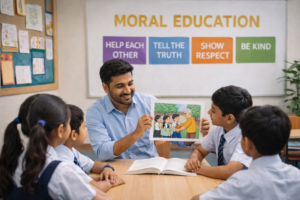
Role of Moral Education in Schools
Moral education emphasizes good character, trustworthiness, fairness, and respect for parents, teachers, and society. These values should not remain confined to moral science lessons; rather, they should be reflected in daily school practices, interactions, and decision-making processes. Such moral grounding helps students develop a strong sense of accountability, discipline, and social responsibility.
Strategies Schools Must Adopt
Integration of Moral Values: Moral education should be woven into all subjects and school activities. Values are best learned through consistent practice, not isolated lessons.
Teachers as Role Models: Teachers play a decisive role in behavioural modification. Their conduct, fairness, and empathy strongly influence students’ attitudes and actions.
Activity- and Experience-Based Learning: Group work, community service, and leadership opportunities help students internalize cooperation, responsibility, and compassion.
Emotional and Social Development: Schools must provide space for self-reflection, emotional growth, and ethical awareness, which are essential for healthy personality development.
 Positive School Environment: Discipline should be reformative rather than punitive. A respectful and caring school environment encourages positive behavioural change.
Parent–School Partnership: Behavioural development is most effective when schools and parents work together with shared values and consistent guidance.
Conclusion
Education that neglects moral and behavioural development remains incomplete. Subject teaching alone cannot prepare students for the ethical and social challenges of real life. A holistic educational strategy—strengthened by strong moral values—can truly achieve the objective of education: the positive transformation of human behaviour.
The author is a retired higher secondary principal.