McDonaldization: The Price of Perfection
BY : ANEEQA FARAZ
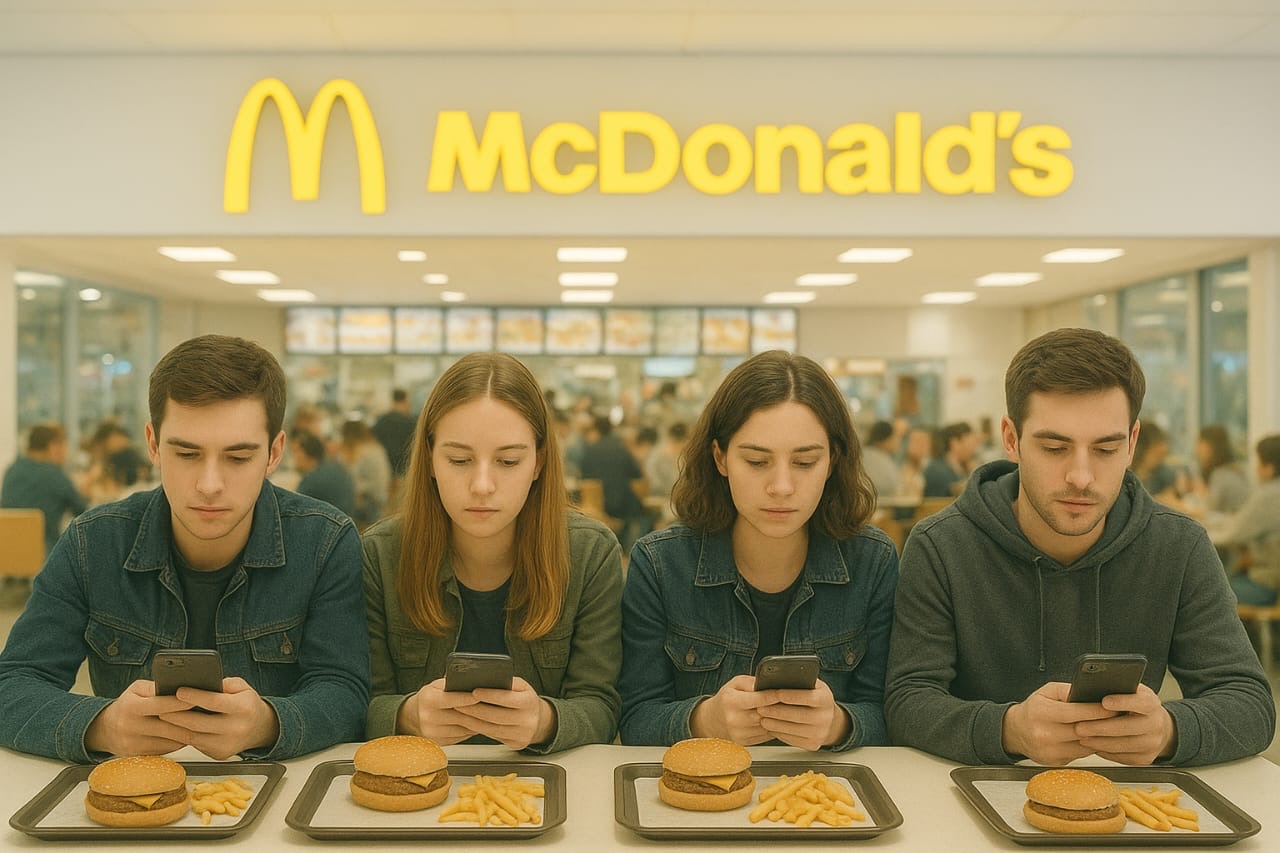
Imagine this: it’s a Saturday evening. The city glows with neon lights, laughter spills from
cafes, and a group of friends steps into a fast-food restaurant. Within minutes, trays arrive
burgers perfectly assembled, fries golden and crisp, drinks filled to identical levels.
Everything looks flawless, familiar, and fast. They eat, they chat, and soon they leave
satisfied, but in a hurry to catch a movie.
Now pause for a moment. What seems like an ordinary, harmless meal is, in truth, a quiet
reflection of our times. Beneath the fluorescent lights and cheerful music lies a pattern that
defines much more than what’s on our trays. It’s the rhythm of our modern lives fast,
uniform, and endlessly repeatable.
What we see here isn’t just food being served; it’s a mirror of how the world now functions
built on efficiency,calculability, predictability, and control. Sociologist George Ritzer called
this phenomenon McDonalisation the process through which the principles of the fast-food
industry have seeped into nearly every aspect of society, from how we learn and work to
how we’re governed and even how we think.
In his 1993 book The McDonaldization of Society, Ritzer explained how four core
principles efficiency, calculability, predictability, and control now shape almost every
modern institution. What began as a model for selling burgers and fries has quietly evolved
into a blueprint for running classrooms, offices, hospitals, and even governments.
Each of these principles appears harmless, even helpful. After all, who wouldn’t want things
to be efficient, measurable, reliable, and organised? But Ritzer’s warning was subtle: when
these principles dominate , they reshape not only processes but human experience itself.
We begin to think, behave, and even feel in ways that mirror machine logic – faster, more
standardized and less human .
To understand how deeply this pattern runs far beyond the counter of a restaurant , we can
look at these principles one by one , not through theories alone, but through glimpses of our
own everyday life.
EFFICIENCY — THE SHORTCUT CULTURE Efficiency is everywhere today. It whispers that the fastest way to do something is the best
way. It promises to save time, reduce effort, and make life smoother. And often, it does. But
as sociologist George Ritzer warned in his theory of McDonaldization, efficiency is not just
about speed its about control.Its about designing life so that everything becomes predictable
measurable and perfectly managed .
On paper, that sounds ideal. In practice, it makes life mechanical. It replaces patience with
haste, process with product, and meaning with measurement.
Take education, for instance. Online courses promise degrees in months. The syllabus is
covered, lectures are recorded, progress is easily tracked. It’s efficient. But what disappears
is the human experience of learning , the teacher’s untold stories that shape our worldviews,
the class debates that challenge our assumptions, the friendships that form in shared
confusion, the laughter, the warmth, the mentorship. These moments don’t exist in
efficiency’s plan, because they can’t be timed or quantified. Yet they are the moments that
truly educate us in empathy, patience, and thought .
Look at food. Frozen meals, instant noodles, or pre-cooked patties fill our plates within
minutes. They’re convenient. But in chasing convenience, we also consume preservatives,
artificial flavors, and a quiet detachment from the act of cooking , from the joy of stirring,
tasting, and sharing something made with care. Efficiency feeds us quickly, but it starves
something deeper: the sense of creation and connection that makes a food , a meal .
Cooking together once fed our hunger and our hearts .Efficiency feeds only one .
Even in governance, efficiency often hides its flaws behind the illusion of progress. A farmer
in Pulwama now receives his subsidy directly into his bank account. The process is smooth,
digital, and quick , a success, on paper. But his land is still dry, his tools are still outdated,
and no one has taught him better ways to farm. The root problems, water scarcity, training,
soil degradation , remain untouched.
The system celebrates its success because the transaction was efficient, not because the life
improved. Efficiency delivered speed, but not solution. It fixed the form, not the foundation.
Once a process is made efficient, we naturally begin to measure it , to count how much time
it saves, how many people it serves, how many results it produces. And that’s how
efficiency quietly breeds calculability.
Calculability — When Life Becomes a Number Numbers dominate our imagination. How many calories we eat, how many chapters we’ve
completed, how many likes or followers we have, how many stars a movie gets. The more
we count, the less we pause to ask: Was this experience meaningful? Calculability teaches us
to value quantity over quality, measurable outcomes over lived experience. It makes life
neat, countable, and predictable but often at the cost of depth and feeling.
Take, for instance, a simple picnic or a visit to a beautiful restaurant. We savor the meal, the
coffee, the view and yet, the urge to capture it on camera arises. We think, If the picture
isn’t clicked, did this moment even happen? Later, the worth of that experience is judged by
the number of likes the post receives. The richness of the memory, the laughter shared, the
smell of the coffee, the warmth of the company all of that is overshadowed by numbers.
Similarly, in education and governance, calculability becomes dangerously visible. Speeches
boast of 1,000 new schools built or a hospital opened in the farthest regions. On paper, it
looks organized, measurable, and impressive. But the reality is far different: many of these
schools have no teachers assigned, no books for students, underqualified staff, or no proper
heating arrangement in cold areas. The numbers suggest progress, but the quality , the true
impact on human lives is missing.
What do we learn from this? Calculability makes it easy to celebrate what can be counted
while ignoring what cannot. Likes, certificates, or schools built are measurable; empathy,
mentorship, nourishment, and true learning are not. By focusing only on what is
quantifiable, we risk measuring life while forgetting to live it.
In the end, calculability is subtle but profound in its danger. It convinces us that numbers
define success, and that bigger or faster automatically means better. But the human heart,
experience, understanding , and warmth cannot be measured. Calculability may organize
the world, but it cannot enrich it. And in that gap, we begin to lose something essential: the
depth, meaning, and humanity of our lives.Once everything is counted and measured we
start expecting life to follow predictable patterns the same outcomes , the same rules ,the
same experiences,and that desire for uniformity marks the next principle of modern life :
predictability

Predictability — Life on Repeat
Predictability promises order. It tells us that if we follow the rules, if we arrive on time, if we
stick to the script, everything will work. A burger in Delhi tastes exactly like one in Dubai.A school in a remote village follows the same syllabus as one in the city. Government
offices follow identical rules everywhere. On paper, life is neat, organized, and reliable.
But life rarely fits neatly into a template. Take a poor family in Marwah, a snowbound
village in the mountains. They leave early to collect their monthly ration, but the road is
blocked by heavy snow. They wait, struggle, and eventually return home empty-handed.
The system treated them the same as anyone else, but it could not account for the
unexpected, the messy reality of life in a remote village.
Similarly, in a nearby town, a man arrives at the ration shop on time. He stands patiently in
line, carrying his ID. But when the biometric scanner fails to read his fingerprint, the system
marks him absent. He leaves without his share, helpless, though he was present in every
meaningful sense. Predictability has created order, yes, but at the cost of human
understanding, flexibility, and compassion.
Even schools reflect the same rigidity. Biometric attendance ensures that students and
teachers are present at exact times. A teacher caught in traffic, a student delayed by a broken
bus, or a brief technical glitch can mark them as “late.” Lessons are rushed to fit the clock.
Spontaneous discussions, questions that ignite curiosity, or stories that linger in memory all
are sacrificed to uniformity.
Daily life, too, bends to its rules. Streaming apps suggest the same shows, office routines
march on the dot, supermarkets align every product the same way. Festivals, birthdays, and
morning routines follow predictable patterns. There is safety in predictability, yes, but also
monotony. The little surprises, the improvisations, the joys of the unexpected they quietly
vanish.
Predictability is appealing because it makes the world orderly and measurable. But in giving
us certainty, it quietly steals the unpredictable, messy, human parts of life. Spontaneous
laughter in a classroom, a friend arriving late with a story, or the thrill of discovering
something new these moments cannot be scheduled or standardized and where
predictability organizes ,Control directs .
Control — When Systems Decide for Us .
To keep things efficient and predictable, modern systems increasingly try to control not just
outcomes, but behaviour itself. In George Ritzer’s view, control is achieved by replacinghuman choices with automated processes, strict rules, and technologies that guide or limit
how people act. The goal is to reduce error, speed things up, and ensure uniform results. But
in doing so, something vital is lost: human freedom, flexibility, and feeling.
Take a fast-food restaurant. Here, employees don’t cook with creativity or instinct. They
follow detailed procedures: press this button, flip the patty when the timer beeps, wrap the
burger in exactly ten seconds. Machines and systems make the decisions not the worker.
The job becomes mechanical, repetitive, and controlled down to the second. It runs
smoothly, but leaves little room for thought, care, or connection.
The same happens in schools and classrooms. Teachers are often told what to teach, when
to teach it, and how long to teach . Students line up, take their seats, and follow the bell to
the minute. Teachers follow lesson plans, not improvising, because time, curriculum, and
biometric attendance leave no room for flexibility.
Even a curious question, a spontaneous
discussion, or a creative activity must fit into the system. The system decides what, when,
and how learning happens. Students and teachers are technically “free,” but in reality, their
actions are constrained by the procedures designed to keep the classroom orderly.
In hospitals too, control is quietly at work. Doctors are expected to follow rigid protocols, and see patients
within tight time slots. A physician may feel the need to say a reasuuring word or few moments of deeper
conversation but yet the system leaves less room for these human touches . In the name of efficiency, care
becomes transactional. The warmth of a reassuring word, the time to listen, the trust built through small acts
these human moments fade away.
Control can make systems faster and more reliable. But when taken too far, it turns people into parts of a
machine present, functioning, but disconnected. Ritzer warns us that when every task is guided by rules, and
every decision shaped by systems, we begin to lose what makes us human: the ability to think freely, act with
empathy, and respond with care. The world may run more smoothly, but at the cost of depth, dignity, and the
unpredictable beauty of human connection.
McDonaldization comforts us. Convenience feels safe. Numbers give an illusion of progress. Predictability
feels secure, and control reassures us that corruption is checked. We begin to like the very cage that confines
us.
But in this pursuit, the richness of life its spontaneity, compassion, and creativity is quietly pushed out. A
family meal at home is slow, messy, but deeply human. A teacher’s offhand story in class may not mark in
exam marks but it becomes a wholesome experience .
So the question remains: how much of our lives are we willing to run like fast-food chains?
Burgers are meant to be identical. Lives aren’t.
And if we forget that difference, we risk building a world that is efficient, measurable, predictable, controlled
but hollow.
Yet it doesn’t have to be this way. The antidote to McDonaldization is not rejection, but reconnection to the
slow, the personal, the imperfect. As citizens, as students, as ordinary people, we can choose to pause where
the world hurries. To listen before replying. To cook instead of ordering. To read deeply instead of scrolling
endlessly. To meet a friend without photographing the moment .To listen to a person instead of a podcast .Systems may run on efficiency, but societies thrive on empathy. The challenge, then, is not just to make life
faster, but to make it fuller. Not to perfect the experience but to truly live it .
And imagine the same scene
The same Saturday evening. The city glows with neon lights, laughter spills from cafés, and a group of friends
steps into a familiar restaurant. Trays arrive burgers and fries, drinks poured, everything served promptly. But
this time, it feels different. They don’t rush. They notice the warmth of the food, the slight unevenness of a
burger, the crispness of fries that isn’t perfectly uniform.
They talk and laugh, letting conversations drift naturally, pausing to tell small stories, tease, and really listen to
one another. One friend hums a tune softly, and another teases him about how he used to sing it for someone
who’s no longer around, making everyone laugh. A crumb falls onto the table, and someone gently wipes it
from a friend’s plate. In the middle of this another friend yelps as hot fry has burned his mouth .Someone else
reaches over to taste a fry from another’s tray, smiling at the tiny shared indulgence. Nobody takes photos of
the food; drinks are sipped slowly, bites savored, ketchup passed with a grin. A friend notices someone
shivering slightly from the air conditioning and offers a jacket. The music plays softly, unnoticed at first, then
becomes part of their shared memory.
Compared to the usual routine, the conversation might have been the same, the jokes familiar, yet something
has changed. Now there is space to notice, moments to linger, and attention to the small details that make life
human. The meal isn’t just about eating; it’s about being together, feeling together, teasing, caring,
remembering a simple, messy, imperfectly perfect experience that leaves warmth behind long after the
trays are cleared