We support landless locals,not land mafias: Tahir Syeed
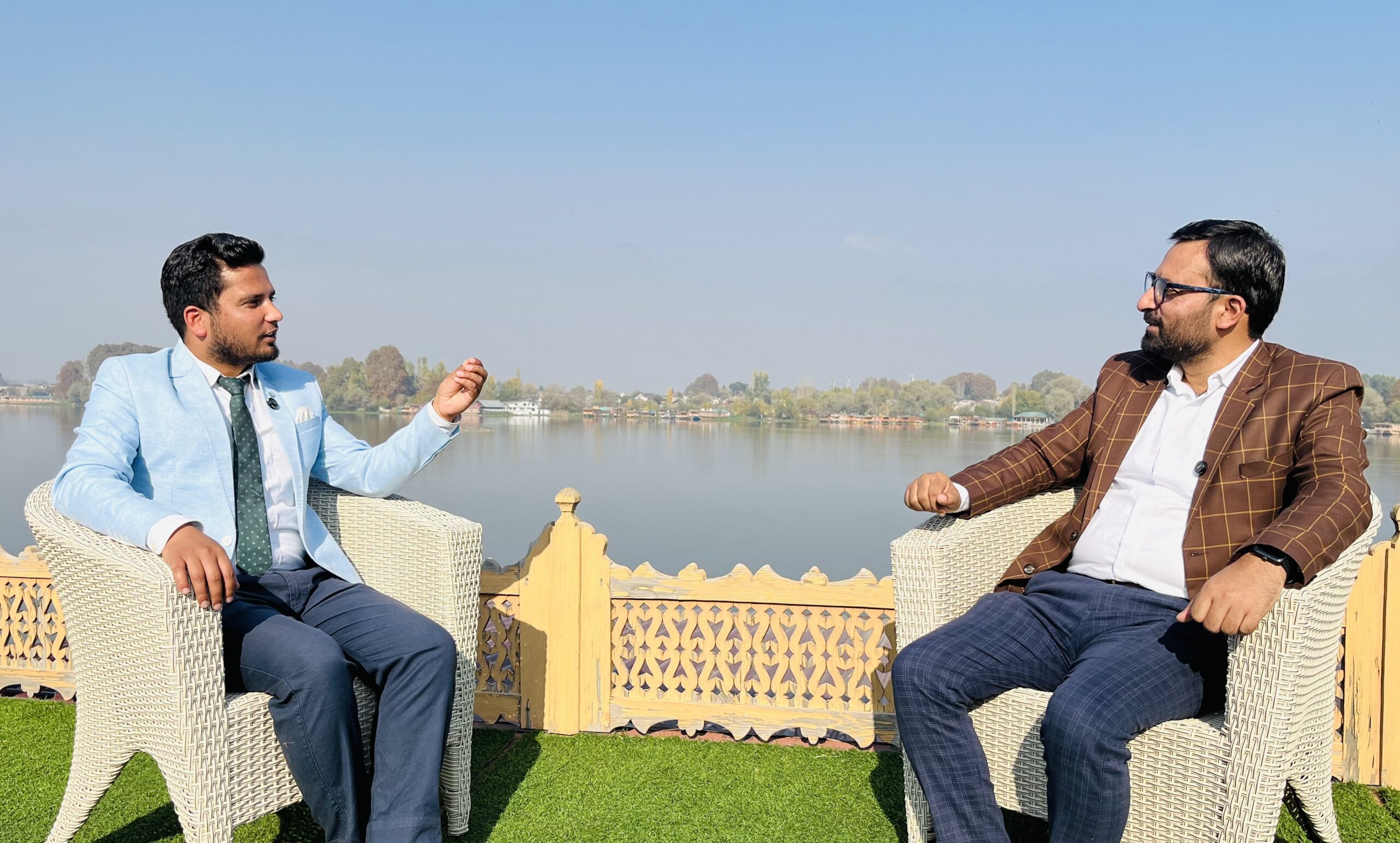
In this excerpt from the Rubaroo interview series, Faizan Qureshi speaks with National Conference spokesperson and former journalist Tahir Syeed about his journey from journalism to politics, the party’s one-year report card, and the current political landscape in Jammu and Kashmir.
Faizan Qureshi: You began your career in journalism before moving into politics. What inspired that transition?
Tahir Syeed: Journalism taught me to observe closely — politics taught me to act. I began writing letters to editors even as a student, and by 2006 I was working in the field. Reporting exposed me to the system’s realities up close. Over time, I realized that writing about issues was not enough; one has to be part of the process that brings change. Politics seemed the natural continuation of that journey.
Politics also ran in the family — my grandfather, uncle, and father were all involved in public life. Growing up in that environment shaped my thinking. Journalism gave me perspective; politics gave me purpose.
Faizan Qureshi: Your family had long ties with the National Conference, yet you first joined the PDP. Why?
Tahir Syeed: Initially, I was supposed to join the National Conference. I had even met Omar Abdullah, and discussions with the party’s leadership were underway. But a communication gap emerged at the last moment, and the move didn’t materialize.
Around the 2014 elections, the PDP projected a youth-centric vision — space for young people, fresh ideas, and a modern outlook. That attracted me. Their manifesto placed youth at the centre, promising opportunities and inclusion. Unfortunately, much of it later remained unimplemented. But at that time, the energy and intent appealed to me.
Faizan Qureshi: Critics claim the National Conference has changed its core stance over the years. How do you respond?
Tahir Syeed: Flexibility is not weakness. No political party can survive without adapting to time and circumstance. But adaptation is not abandonment. The National Conference has never deviated from its fundamental principles — democracy, dignity, and self-respect.
When we adjust our strategy, it’s to serve those goals better, not to compromise them. Just as a farmer adjusts his sowing to the season but still seeks the same harvest, our objective — serving the people — remains constant.
Faizan Qureshi: Some senior figures within your party have recently made statements that seem to contradict the leadership’s position. Is there internal discord?
Tahir Syeed: Absolutely not. Differences of opinion exist in every organization — even in families. Leaders like Ruhullah Mehdi or Mian Altaf are seasoned politicians. They’ve raised concerns, and both have clarified the context of their remarks.
Healthy debate strengthens a party. What matters is how those differences are expressed. There are internal forums for discussion. Taking disagreements to the media only benefits opponents. The National Conference remains united under Omar Abdullah’s leadership.
Faizan Qureshi: Voters say the NC’s manifesto promises remain unfulfilled.
Tahir Syeed: Implementation takes time, especially after the administrative upheaval we inherited. Remember, after the state’s downgrade to a Union Territory, the entire governance system was paralyzed under bureaucracy.
Despite that, we laid strong foundations — schemes for the poor, subsidized electricity, expanded ration benefits, bus services, and revised age limits for civil service aspirants. These are concrete steps taken in just one year. Some commitments require full statehood to implement, but the direction is clear.
Faizan Qureshi: The Rajya Sabha elections brought accusations of cross-voting and match-fixing against the NC. What’s your clarification?
Tahir Syeed: The charge is baseless. Rajya Sabha voting is open, not secret. Every MLA must show the marked ballot to the party’s authorized agent before casting it. The National Conference had forty-one votes, and every single one was accounted for under the party whip.
If irregularities occurred, they were among independents or smaller parties without agents. None of our votes went astray.
Faizan Qureshi: Does the party truly give young leaders a chance, or are decisions still limited to a few?
Tahir Syeed: Every party has a structure for decision-making — committees, boards, and consultations. The so-called “kitchen cabinet” narrative exists only outside the party. Inside, decisions follow due process.
New leadership does emerge, but politics is not handed on a platter. One must work, prove loyalty, and earn trust. Those who do inevitably rise. No one is denied opportunity, but nothing comes without struggle.
Faizan Qureshi: The Assembly recently rejected a bill on land regularization brought by PDP’s Waheed Para. Why oppose it?
Tahir Syeed: Because it was misleading. It wasn’t a government bill but a private member’s bill, which rarely becomes law in India due to legal inconsistencies. The proposal sought to regularize land occupied after 2019 — effectively legitimizing encroachments by outsiders and powerful land mafias.
Passing it would have legalized thousands of kanals seized illegally. It had nothing to do with helping the poor; it was about demographic manipulation. Our stance was clear: we support genuine landless locals, not vested interests seeking backdoor ownership.
Faizan Qureshi: Can your party’s manifesto be fulfilled without restoring full statehood?
Tahir Syeed: Not entirely. When Omar Abdullah released the manifesto, he clearly said that several commitments require statehood to be meaningful. The central government itself said restoration is a process — delimitation, elections, then statehood.
We drafted our promises in that context. Some goals are achievable now; others await political restoration. But by the end of our tenure, we’ll fulfill every feasible commitment under the current structure.
Faizan Qureshi: You spent nearly a decade in the PDP before resigning. What triggered that decision?
Tahir Syeed: The immediate trigger was the manipulation of mandates, but the deeper reason was principle. After 2018, the PDP vowed to rebuild with new leadership and keep doors closed to those who had undermined the party. I supported that.
But then, the same people — once branded as “garbage,” as traitors — were brought back and celebrated. Those of us who stood loyal through the toughest times were sidelined. That betrayal of conviction made it impossible to stay