
Reservation: JK’s Frankenstein?
Yawer Hussain
Srinagar: With open merit reduced to a minority status in Jammu and Kashmir, the union territory government’s Cabinet Sub-Committee report and subsequent legal opinion seeking has led to the issue becoming a political hot cake, which every party desires to savour.
However, sources within the Law department reveal that the Jammu and Kashmir Reservation Act 2004 empowers the Union Territory Legislature to rework the percentages allocated to any category.
A senior ranking law department official, wishing anonymity, said that post the reading down of Article 370, 80 percent of the legislative acts prevalent then were revoked by parliament, while 20 percent, including the Jammu and Kashmir Reservation Act 2004, were retained.
“The Administrative Council under Lieutenant Governor in last March cited Article 23 of this Act to rework the reservation percentages granted to various categories,” the official said.
He said that it is legally injudicious to state that parliament has allocated the percentages of reservation enjoyed by various categories in Jammu and Kashmir.
“The parliament, which had legislative power in the absence of an assembly in Jammu and Kashmir, only notified that 15 castes would be added to the Other Backward Caste (OBC) category and Paharis along with a few other communities would be added to the Scheduled Tribe (ST) category. The parliament also had extended a maximum of 10 percent reservation for Economically Weaker Sections (EWS),” the official said, adding that percentages for these categories were set by the Administrative Council, which has now been replaced by the elected assembly.
Another official privy to the developments said that people in ST, SC, EWS and OBC categories are now protected by the acts of parliament and the Union Territory legislature can’t take any of them out, but the reservation percentage accorded to them is still with the J&K legislature.
،“The acts passed by parliament last year and even prior have only notified who is a member of a particular category. Parliament never gave them any percentages. A simple amendment to the act by the NC-led government can change these percentages,” the official revealed.
Open Merit’s Collapse
After the fall of the BJPDP (Bharatiya Janata Party-Peoples Democratic Party) alliance government in June 2018, the reservation arithmetic in the region changed drastically. In June 2019, under President’s rule in the erstwhile state, the BJP-led central government extended a maximum of 10 percent reservation to EWS in Jammu and Kashmir in line with the national level.
However, the rider here was that 10 percent can be the maximum percentage of reservation which can be accorded under the category, meaning that the percentage of EWS reservation in J&K could have been lower. As per official data, the EWS beneficiaries in J&K stand at just 29000 odd but still they are getting the highest reservation percentage of 10 percent.
In January 2020, the BJP-led central government again tweaked the reservation numbers by bringing Pahari community, a language-based people, under the Socially and Economically Backward Classes, followed by the Administrative Council under the then Lieutenant Governor, extending four percent to the community.
Last year in March, following a parliamentary act the Pahari, Gadda Brahman, Paddari and Koli communities were declared as part of ST fold, leading to the Administrative Council (AC) under LG Manoj Sinha, assuming the UT legislature’s role, to provide 10 percent reservation to the communities. The AC also kept the separate 10 percent ST reservation quota for the Gujjar-Bakerwal community which they enjoyed since 1991.
In the same meeting, the Administrative Council (AC) also approved the addition of 15 new castes in the Other Backward Castes category, taking the total castes to 42. The AC also enhanced the reservation of OBCs from the earlier four percent to eight percent. In 2024, a parliamentary act introduced the Other Backward Caste category in Jammu and Kashmir by replacing the Other Social Castes category.
Category 2018 2024
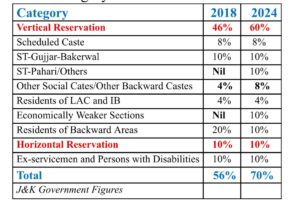
The AC also tweaked the reservation for the Reserved Backward Areas (RBA) category by bringing down their percentage from 20 percent to 10 percent in Jammu and Kashmir. The RBA, a category only in Jammu and Kashmir, was based on the principle that various areas in the region are backward in nature, leaving the residents of these areas at a disadvantage in comparison to others.
Petitioner Argument
Following these changes in reservation numbers, the open merit category was left with just 30 percent odd seats, leading to stakeholders knocking the doors of Jammu and Kashmir High Court, where the matter is currently sub-judice.
Advocate Zahoor Ahmad, himself a petitioner in the case, said that the UT government, led by the National Conference and the LG-led J&K Advocate General’s office, aren’t taking a clear stand in public on the issue.
“In court, the Advocate General’s office, on LG’s orders, has been saying that the case has no locus standi because the government is well within its rights to help people who are deprived of any benefits. They say giving a reservation is one of the cornerstones of a welfare state,” Ahmad said.
He said that the NC government, on the other hand, seems happy that the Advocate General’s office, which represents the government in courts, is with the LG, as this provides them an escape route.
He said that the petitioners aren’t against reservation to any one category, but then the reservation percentage is to be streamlined as per the Apex Court guideline, which says that at least 50 percent of the seats should be kept for the open merit category.
“In many states in India, the SC, ST and OBC populations are above 60 percent but yet these states have a cap of 50 percent as per the SC directions. The SC had set the rule because when a student from a reserved category tops an exam or scores good, he/she is deemed to have taken the seat from the open category while his/her reserved seat becomes vacant for another reserved category student,” Ahmad said.
“The reserved category student has a claim on both the reserved as well as open merit category seats, while the open merit student has a claim just on the latter.”
Another petitioner in the case said that they have also challenged and argued that certain laws in India advise that some service sectors shouldn’t have any reservation quota at all.
“For instance, when a person appears to be a medical surgeon, it isn’t empirical to give that position to a person just because he/she is from a reserved category. At this point, he/she is already a doctor on a reserved seat. Here, competence should be given preference,” the petitioner said, adding that there are many other such positions which they are asking the court to get out of the reservation bucket.
The petitioner said that their arguments are also based on Article 16 of the Indian Constitution, which guarantees equality of opportunity in matters of public employment for all citizens.
“Article 16 does allow the state to make special provisions for backward classes, including SCs and STs, and other economically weaker sections, but then it is a balancing Article and is part of a citizen’s fundamental rights,” the petitioner added.
The Protest
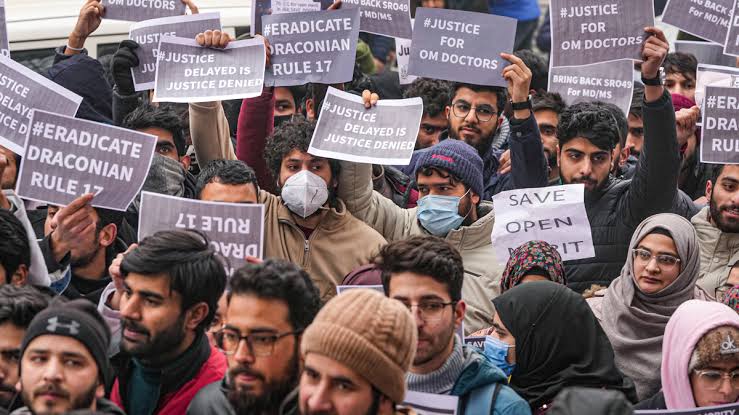
The open merit category students, who last winter protested outside the residence of Chief Minister Omar Abdullah, say that after the news broke that Cabinet Sub-Committee (CSC) report is yet to be received by the Law Department, they are mulling to hit the streets to protest like the Gujjar-Bakerwal community did a couple of years ago to safeguard their reservation quota.
Sahil Parray, a representative of the Open Merit Students Association (OMSA), said that they have recently sent two separate letters to Chief Minister Omar Abdullah and CSC Chairperson Sakina Ittoo, asking them for expediting the file in the Law Department, along with asking for the report to be made public.
“We also demanded that future decisions should be taken by getting all stakeholders on board. We have also demanded a halt on recruitments till the issue is solved,” Parray said.
An OMSA representative group said that the announcement of the finalisation of the CSC report on reservation by the government on the last day of the six-month deadline in itself reflects how serious they are.
Sahil Parray said that one of the solutions to the issue can be that the government introduces division-wise reservation for Kashmir and Jammu, respectively.
“See, if there are 1000 jobs, let 500 go to each division first. Then among these 500, each division can have a reservation for all current reserved categories, but the percentages in Kashmir and Jammu would be according to the population of each category. This is the easiest way to solve this issue,” he said.
Recently, Jammu and Kashmir Student Association (JKSA), a self-styled group, said that they had filed a query under the Right To Information Act seeking the details of the meeting chief minister had with protesting students outside his residence last winter.
“The meeting on December 23, 2024, was completely informal and unofficial, with no official records, minutes of meetings, or follow-up actions documented,” the JKSA statement claimed, adding that the information raises concerns on the transparency, accountability and seriousness of the government to solve grievances of students.
Political Mudslinging
The politics around reservation in Jammu and Kashmir has had a long history, with parties at different times employing different manoeuvres to counter each other while also trying to take credit for themselves.
In 1991, the Congress government under Narasimha Rao accorded ST status to the Gujjar-Bakerwal community at the height of militancy in the region. The Gujjar-Bakerwals, 99 percent Muslims, mostly live in the areas along on the Line of Control.
The reservation fulfilled a long-cherished demand of the community while the Paharis, also living in the same ecosystem, felt left out. Paharis, a language-based community with upper caste Muslims, Hindus and even Sikhs, are better-off than the nomadic Gujjar-Bakerwal community, who also aren’t landed like the former.
The politics for reservation to the Pahari community started in the 1990s but it was the Omar Abdullah-led coalition government in 2014 that passed a bill in both the houses of the then J&K Legislature to grant four percent reservation to Pahari-speaking people.
However, the Bill was returned by the then J&K Governor Narinder Nath Vohra, citing legal and other deficiencies. The Bill was then forwarded to the Law Department and then to the Department of Social Welfare, which further sent it to the State Commission for Backward Classes (SCBC) in February 2015.
Till then, the BJPDP government had come to office with NC and Congress both losing badly in Rajouri and Poonch districts, which have a large chunk of Pahari voters. However, the Bill kept gathering dust as SCBC was headless till 2017.
The SCBC made fresh recommendations leading to a new Bill proposing three percent reservation to the Pahari Speaking People, which was again passed in both Houses on February 10, 2018. However, Governor Vohra again sought clarification on the veracity of the claims put forth for declaring the community as ‘Reserved Category’.
Subsequently, the matter was again referred to the J&K State Commission for Backward Classes.
It was this reservation issue that the BJP-led central government took up to initially grant three percent reservation to the Pahari community and then induct them into the ST fold to grant them 10 percent reservation in March last year.
The Valley-based parties, including the NC, PDP and Apni Party, all lent their support for the Pahari reservation as they all have stakes in the community.
BJP, eyeing an electoral benefit in lieu of the reservation to Paharis, also tried to pacify the protesting Gujjar-Bakerwal community, who were afraid of losing their quota in the ST fold if the Pahari community got in. In 2022, Union Home Minister Amit Shah in a public rally in Rajouri assured the Gujjar-Bakerwal community that they won’t be deprived of their reservation share at all.
Still, in last year’s parliament and assembly polls, the BJP and its then alleged ally Apni Party couldn’t reap any political benefit out of the reservation to the Pahari community. The NC’s Gujjar candidate, Mian Altaf Ahmad, defeated Apni Party’s Pahari candidate Zaffar Manhas by a huge margin. The BJP didn’t even put up a candidate for the parliament seat, while the PDP’s Chief Mehbooba Mufti was runner-up for the seat. Four months later, the NC swept all eight seats in the Rajouri and Poonch districts.
A senior Valley-based journalist said that the NC, PDP and Apni Party are all caught in doldrums as they can’t commit to bringing down the percentages of either the Gujjar-Bakerwal or Pahari communities.
“They all have senior leaders and voters in the two communities. Any rationalisation would involve these communities. On the other hand, the biggest losers currently, due to high reservation percentages, are Kashmiri people who mostly fall under the general category. They also are the main voter base for these three parties, while the BJP has more stakes in the Jammu region,” the journalist said.
Along with the Pahari community, the Paddari community of Kishtwar was also brought under the ST fold by the BJP-led central government last year. The BJP did better in the Chenab Valley region in both the parliament and assembly elections of last year.
The current politicking around reservation mainly stemmed from the National Conference’s assembly election manifesto, which promised a “rationalisation” of reservation percentages, if the party is voted to power.
Just two months into power, the NC government faced a protest organised by its firebrand Srinagar parliamentarian, Aga Syed Ruhullah Mehdi. Mehdi, who has had a hot and cold relationship with NC since government formation, announced that anyone desirous to protest peacefully can join him. While the general category students did join in large numbers, it was NC’s arch rivals from PDP and other parties who became an eyesore for the party. Mehdi’s party colleagues hit out at him for the protest while he paid in the same kind.
Chief Minister Omar Abdullah, who had reached Srinagar just a day before from Jammu, met the protesting students and assured that a Cabinet Sub-Committee would look into the issue and present a report within six months. It is this CSC report which has become a bone of contention for the NC government in particular and other parties in general.
PDP’s Pulwama MLA Waheed-ur-Rehman Parra, who once faced reprimand from his party for talking against reservation, had also joined the protesting students under Mehdi.
He says that there is no room for secrecy in a democracy, and that is why institutions must draw legitimacy from transparency, not concealment.
“The NC government has no legal or moral ground to withhold the subcommittee’s report on the rationalisation of reservation.”
Parra warned that PDP would start a peaceful protest across Jammu and Kashmir if the government continues to evade transparency. “If this deliberate evasion continues, we will be left with no choice but to take this peaceful struggle to the streets.”
MLA Zadibal and NC Chief Spokesperson Tanvir Sadiq said that the NC government ensured that the CSC report is submitted on time. “Current reservation issue in J&K isn’t our mess. It is a tricky subject, and we are going to untangle the knot. We will give everyone their rightful reservation.”
Meanwhile, the latest entrant to the reservation politics is Peoples Conference Chairman and MLA Handwara, Sajad Gani Lone. Lone’s question in the assembly brought out the regional disparity in the reservation, leading to him becoming more vocal on the issue.
A Kashmir-based journalist said that while PDP, NC and Apni Party are in a fix on the issue, the PC has less stakes in Pir Panchal, Chenab Valley and Jammu’s Hindu heartland.
“Sajad Lone is pandering to the Kashmiri voters who are at the receiving end because of the reservation system currently in place. NC and PDP are more guarded with their few Kashmir-based leaders speaking on rationalising reservation numbers,” the journalist said.
Reservation Beneficiaries
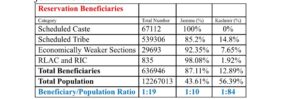
The NC government currently has its Deputy Chief Minister Surinder Choudhary from the Pahari community, while his cabinet colleague Javaid Rana is a Gujjar.
Former Finance Minister Haseeb Drabu recently wrote a three-part series on the reservation issue in a local English newspaper, proposing that an eight percent reservation of Scheduled Castes should be confined to the Jammu division, while the Kashmir region should have zero percent reservation for SCs.
He further proposed that pan J&K reservation of 20 percent currently accorded to Scheduled Tribes should be rationalised by giving 15 percent ST reservation in Jammu and 10 percent in Kashmir. For OBCs, he says the current eight percent reservation should be kept intact for both divisions. The RBA category’s 10 percent reservation, as per Drabu, should be kept intact for both divisions, while current EWS reservation should be brought down to seven percent for both divisions. For people living along the Actual Line of Control, he proposes that two percent reservation for both divisions should replace the current four percent.
He opines that this would take the open merit quota to 50 percent in the Jammu region and 63 percent in the Kashmir division.
With the political clock ticking for the NC government, will it act in time? A reservation on the reservation issue can prove to be a costly ball to duck.